Ethylcellulose | Pharmaceutical Grade Film-Forming Excipient

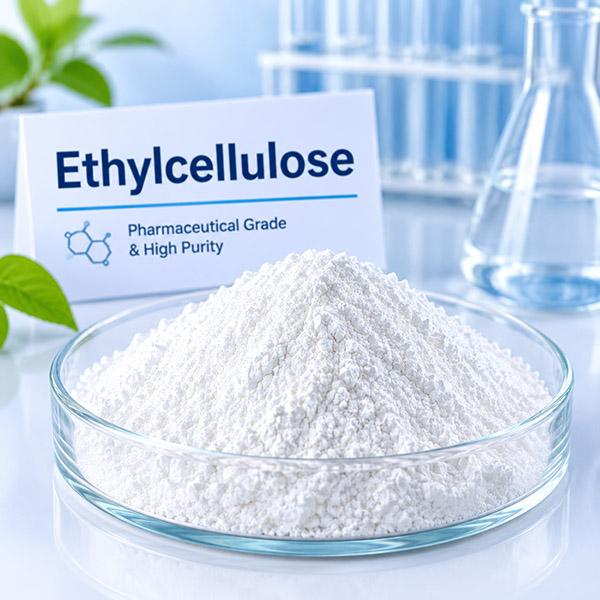
- Wonsen
- China
- 30 days
- Always supply
Ethylcellulose is a water-insoluble cellulose derivative widely used as a pharmaceutical excipient. It offers excellent film-forming properties and is suitable for tablet coating, controlled-release formulations, and moisture protection. Explore Ethylcellulose for pharmaceutical applications.
Ethylcellulose – A Versatile Pharmaceutical Film-Forming Excipient
Ethylcellulose (EC) is a cellulose-derived polymer widely used in the pharmaceutical industry as a functional excipient. It is a water-insoluble, nonionic cellulose ether known for its excellent film-forming properties, chemical stability, and moisture-resistant characteristics.
Ethylcellulose is commonly used in pharmaceutical formulations, particularly for tablet coating, pellet coating, and controlled-release drug delivery systems.
Key Features of Ethylcellulose
Excellent Film-Forming Properties: Forms uniform and durable films for pharmaceutical coating applications.
Water Insolubility: Helps provide moisture-resistant coatings and supports controlled drug release.
Controlled-Release Performance: Can be used to regulate drug release rates in oral pharmaceutical dosage forms.
Chemical Stability: Offers good stability under appropriate formulation and storage conditions.
Versatile Applications: Suitable for various pharmaceutical formulations, including tablets, pellets, and granules.
Applications of Ethylcellulose
Ethylcellulose is widely used in pharmaceutical manufacturing and formulation development.
Tablet Coating: Used as a film-forming polymer to create protective and functional coatings.
Controlled-Release Formulations: Helps control the release of active pharmaceutical ingredients (APIs).
Pellet Coating: Applied in the preparation of coated pellets for modified-release dosage forms.
Granule Coating: Used to modify surface properties and influence drug release.
Pharmaceutical Microencapsulation: Can serve as a polymeric coating material in certain microencapsulation systems.
Comply with USP,BP,EP, CP
Item | USP/BP/EP | CP |
Identification | Conforms | |
Ethoxy (%) | 44–51 | |
Chlorides (%) | ≤ 0.1 | |
Loss on drying (%) | ≤3.0 | |
Residue on ignition (%) | ≤0.5 | ≤0.4 |
Acetaldehyde (%) | ≤0.01 | |
Heavy metal (%) | —— | ≤0.001 |
Arsenic (%) | —— | ≤0.0003 |
Viscosity (mPa.s) (5%,25℃) | 7-200 | |
6 mPa.s or less: 75%-140% of that stated on the label for a nominal viscosity of NMT 6 mPa.s ; Greater than 6 mPa.s: 80%-120% of that stated on the label for a nominal viscosity greater than 6 mPa.s | ||
Microbial limits | Conforms | |
Cas No.: 9004-57-3 HS Code: 39129000
Main Purpose: Tablet binder,filler,thickener.
Package: 12.5kg/fiber drum
G.W.: 15kg
Why Choose Ethylcellulose?
Ethylcellulose is an important pharmaceutical excipient for manufacturers developing functional coatings and modified-release dosage forms. Its water-insoluble nature, film-forming ability, and formulation versatility make it a valuable material in modern pharmaceutical production.
Contact us to learn more about Ethylcellulose specifications, available grades, and pharmaceutical application solutions.
FAQs About Ethylcellulose
Q1: What is Ethylcellulose?
Ethylcellulose (EC) is a cellulose-derived polymer produced by introducing ethyl groups into cellulose. It is a water-insoluble, nonionic polymer widely used as a pharmaceutical excipient, especially in film coating and controlled-release formulations.
Q2: What is Ethylcellulose used for in the pharmaceutical industry?
Ethylcellulose is commonly used for tablet coating, pellet coating, granule coating, controlled-release drug delivery, and pharmaceutical microencapsulation. It helps form functional coatings and regulate drug release.
Q3: Is Ethylcellulose soluble in water?
No. Ethylcellulose is practically insoluble in water. It is soluble in certain organic solvents, depending on its viscosity grade and molecular characteristics.
Q4: Why is Ethylcellulose used in tablet coating?
Ethylcellulose is used in tablet coating because of its excellent film-forming ability and water-insoluble properties. It can form protective films and help control the release of active ingredients.
Q5: Can Ethylcellulose be used for controlled-release drug formulations?
Yes. Ethylcellulose is widely used in controlled-release pharmaceutical formulations. Its water-insoluble polymer structure can act as a diffusion barrier, helping regulate the release of active pharmaceutical ingredients.
Q6: What is the difference between Ethylcellulose and HPMC?
Ethylcellulose and Hydroxypropyl Methylcellulose (HPMC) are both cellulose-derived pharmaceutical polymers, but they have different properties. Ethylcellulose is water-insoluble and commonly used for moisture-resistant coatings and controlled-release applications. HPMC is generally water-soluble and widely used in immediate-release film coatings, binders, and matrix formulations.
Q7: Is Ethylcellulose suitable for pellet coating?
Yes. Ethylcellulose is commonly used as a coating polymer for pharmaceutical pellets. It can help produce functional coatings for modified-release dosage forms.
Q8: What factors should be considered when selecting Ethylcellulose?
Important factors include viscosity grade, ethoxy content, molecular characteristics, particle properties, solvent compatibility, formulation requirements, and intended pharmaceutical application.
Q9: How should Ethylcellulose be stored?
Ethylcellulose should generally be stored in a tightly sealed container in a cool, dry, and well-ventilated place. Protect it from excessive moisture, heat, and incompatible materials. Always follow the supplier's product specifications and safety data sheet.