Polyvinyl Alcohol (PVA) Powder | Industrial Grade Supplier

- Wonsen
- China
- 60 days
- Always Available
Explore Polyvinyl Alcohol (PVA), a versatile water-soluble polymer used in industrial formulations, adhesives, coatings, and selected pharmaceutical applications. Request product specifications and a quotation.
Polyvinyl Alcohol (PVA)
(CDMF NO.: F20209990114)
Name: Polyvinyl Alcohol
Other name: Partially Hydrolyzed Polyvinyl Alcohol; PVA; Airvol; Elvanol; Gohsenol; vinyl alcohol polymer
CAS No.: 9002-89-5
M. F.:(CH2CHOH)n(CH2CHOCOCH3)m
M. W.:20000~220000
Package: 1kg/bag, 5kg/bag/carton, 25kg/drum
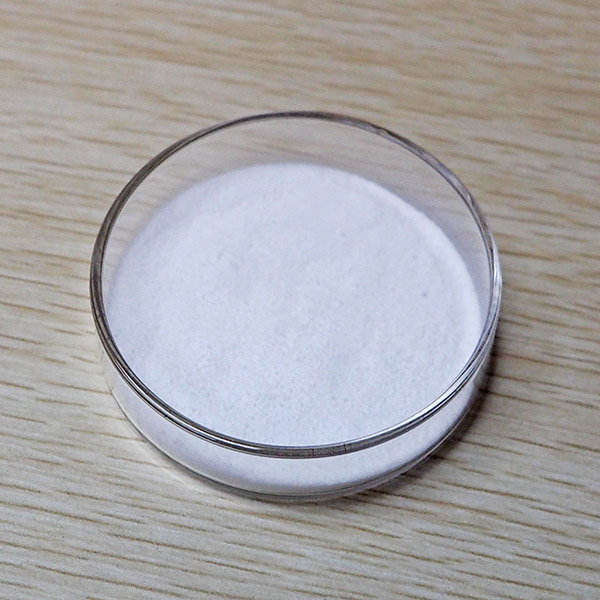
Appearance:
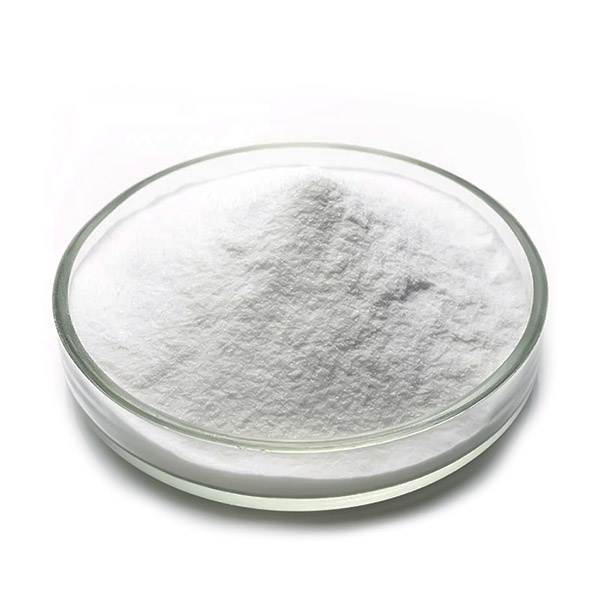
White to yellowish powder or translucent granule.
Medium soluble in ethanol, slightly soluble in acetone, almost insoluble in acetone.
The solubility of PVA XY -88 model is good in hot water and cold water.
Quality Standard: CP2020; USP-NF; EP; JP; GB31630-2014
Features:
Prepared by alcoholysis of polyvinyl acetate in methanol solution by adding alkali solution.
The M. F. is (CH2CHOH) n (CH2CHOCOCH3) m, where ‘m + n’ represents the average degree of polymerization, and m/n should be 0~0.35. The average M. W. shall be 20000 ~ 220000.
There are many types of polyvinyl alcohol according to the degree of polymerization and alcoholysis. The naming rule is “polyvinyl alcohol xy-mn”, where xy represents average degree of polymerization and mn represents degree of alcoholysis.
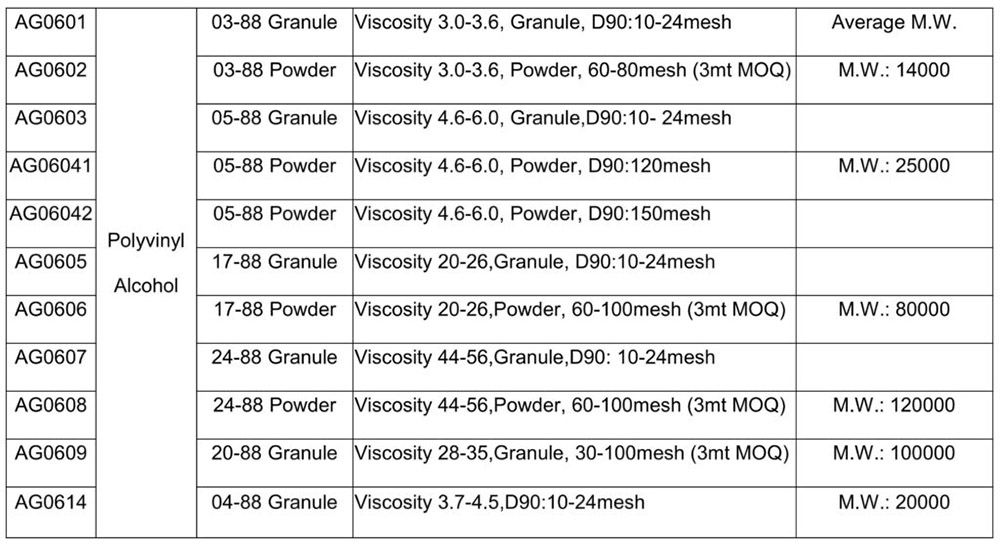
Our company mainly produces models with alcoholysis degree of 88%, including 03-88, 05-88, 17-88, 24-88, 50-88 models, and other models can be customized if necessary.
Product code
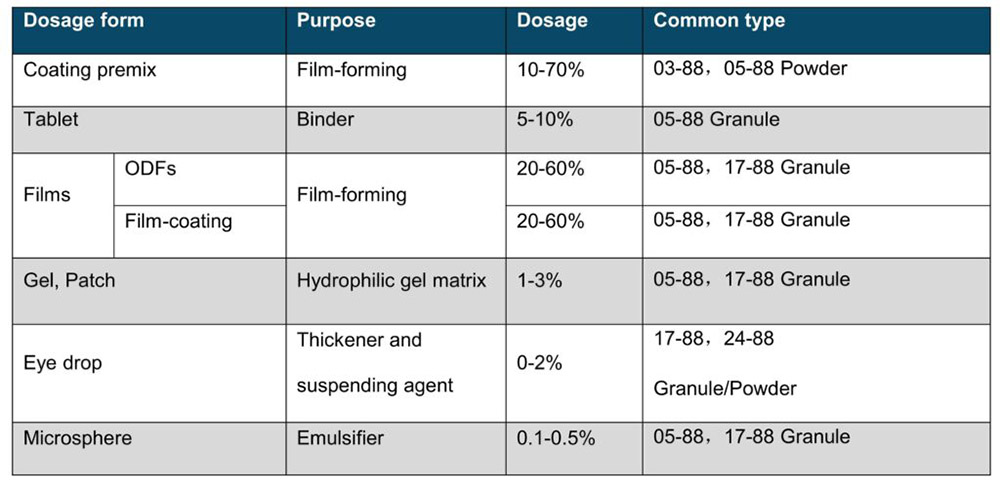
Application:
Incompatibility:
Polyvinyl alcohol has various reactions of secondary hydroxyl compounds, such as esterification reaction. It will drop in strong acids, soften or dissolve in weak acids and alkalis. High concentrations of PVA is incompatibility with inorganic salts, especially sulphate and phosphate. Phosphate can precipitate 5% (W/V) of polyvinyl alcohol. Borax can make PVA forms a gel.
Safety: This product is generally a non-toxic material. When the concentration is as high as 10%, it has no irritation to skin and eyes. Cosmetics can use polyvinyl alcohol with a concentration of up to 7%. Rat experiments show that subcutaneous injection of 5% (W/V) polyvinyl alcohol can cause anemia.
Storage: Preserve in well-closed containers, and store at room temperature in a dry place.
Shelf Life: 2 years.