Dust-Free IBC & Big Bag Discharging Station for Powder Processing

- Wonsen
- China
- 120 days
- Always Available
Our IBC & Big Bag Unloading Station delivers efficient, low-contamination discharge for various powders, tailored for food, chemical, and new energy sectors. With proven performance in real-world production lines, it ensures smooth material transfer while meeting industry hygiene and safety requirements.
Dust-Free IBC & Big Bag Discharge Station for Pharmaceutical Powder Processing
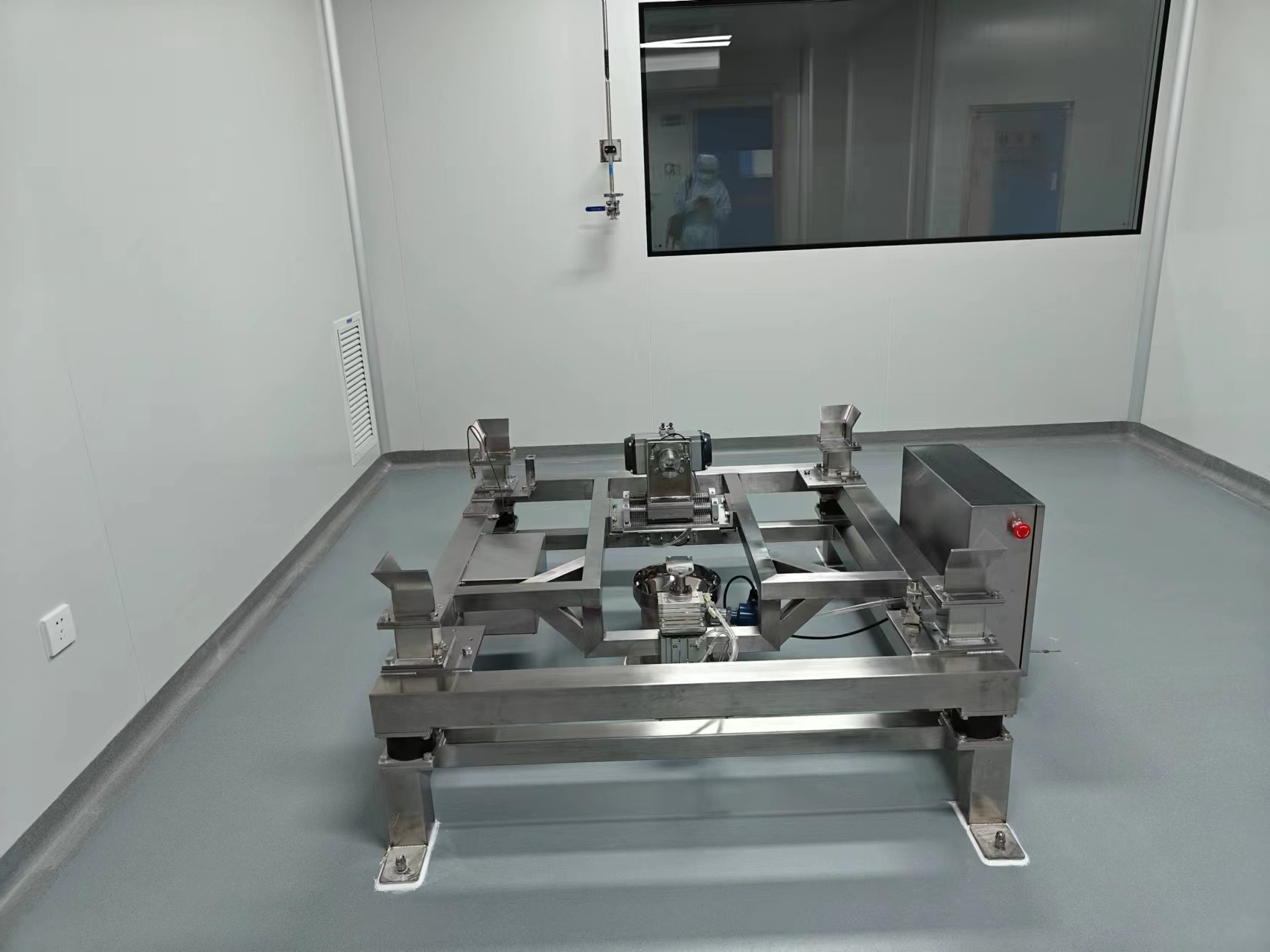
Function
To discharge the materials inside the bin and complete the closed connection with the next process through this device. The entire process of discharging materials can be ensured to be closed, effectively reducing the possibility of material contamination.
The Selection of Structure
The transferring and movement of IBC bins (the method IBC bins are placed in the discharge station) : Currently, there are mainly two methods to move IBC bins in the industry:
One type is to utilize handling tools, such as AGV and forklift. Their characteristic is that when entering the discharge station, the IBC bins will move downward from top to bottom (with a movement distance of more than 50mm).
Another type is translational push, such as manual push. Its feature is that when the IBC bin enters the discharge station, it moves in a horizontal direction, with relatively less or no vertical movement.
Here we introduce two ways of moving the IBC bins because they affect and determine whether the feeding port of the discharge station has the function of automatic docking. The structural difference of this function is:
The non-automatic docking structure controls the small movement of the feeding port of the discharge station in the horizontal and vertical directions through a soft structure (such as a spring) (the movement distance is generally ±5mm, used to compensate for the manufacturing deviation between multiple IBC bins). (Of course, the small movement distance mentioned here is relative to the automatic docking structure.)
The automatic docking structure is driven by a cylinder to lift and move the feeding port of the discharge station in the vertical direction, enabling the feeding port of the discharge station to actively complete the docking with the discharging port of the IBC bin. Similarly, at the connection position between the cylinder and the feeding port of the discharge station, there is also an elastic structure, which is used to compensate for the dimensional deviations and connection position deviations of different IBC bins (both connection methods have this function of compensating for deviations.)
Conclusion
For the movement of IBC bins using handling tools, non-automatic docking structures are more recommended as they are more economical. For the method of pushing the IBC bin by translation, an automatic docking structure is more recommended (this structure may need to be sunken to leave sufficient space for the cylinder structure). Of course, the above recommendations are not fixed. They can be appropriately adjusted according to different customer requirements, which may lead to more structural changes (which will not be elaborated here).
Workflow
Docking
The stacker forklift moves the IBC bin to a position that can connect with the discharge station. After appropriately raising the height of the IBC bin, it moves forward until the IBC bin touches the limit in the direction of movement. Then, the height of the IBC bin begins to decrease. Under the action of the guide limit rod, the IBC bin enters the designated position of the discharge station, thereby ensuring a small deviation.
IBC bin discharging material
A short pipe is installed in advance at the discharging port of the IBC bin, and the short pipe is fixed to the IBC bin by means of a clamp. This short pipe will be inserted into the feeding port of the discharge station when the height of the IBC bin drops. (If the automatic docking structure is selected, it can be manually controlled or equipped with a IBC bin in place detection device. After the IBC bin is in place, after a delay of several seconds, the cylinder will lift and the short pipe will be inserted into the feeding port of the discharge station to complete the automatic docking.) Immediately after, the airbag can be manually controlled to inflate (or the inflation action can be automatically initiated after the cylinder is lifted into place, or the inflation action can be initiated a few seconds later after the IBC bin is in place is confirmed by the IBC bin in place detection device). At this point, the entire device's connection and sealing are completed.
At this point, the automatic valve opening and closing mechanism operates, opening the discharge valve of the material bucket (this valve needs to be specially customized) (this valve can also be equipped with a manual butterfly valve for manual control of opening and closing), and the material enters the discharge station through the valve.
Discharge station discharging material
The discharge from the discharge station needs to be connected to the next process. It can be connected to the interlayer discharge pipe (a device to prevent material stratification) through a soft connection, and then enter the packaging machine, tablet press, capsule filling machine and other equipment. It is also possible to use a vacuum discharger to allow the material to be conveyed under the effect of air pressure and enter the next process.
Discharging completed
During the discharging process of the IBC bin, the vibrator will work intermittently to promote the discharge of materials, ensuring the stable flow of materials and reducing the residue on the wall.
The discharge station is equipped with a material level sensor. When the sensor gives a signal indicating no material, it can be determined whether the discharging is complete or the material discharge is abnormal, and manual intervention is required for corresponding handling.
When discharging is completed, first close the valve, then start the airbag exhaust, and then position the forklift to lift the IBC bin vertically (for those equipped with an automatic docking structure, it can be manually controlled or linked with the IBC bin in place detection device to complete the cylinder descent). After reaching a certain height, the forklift retracts to the designated position to complete the removal of the IBC bin.
Other Options
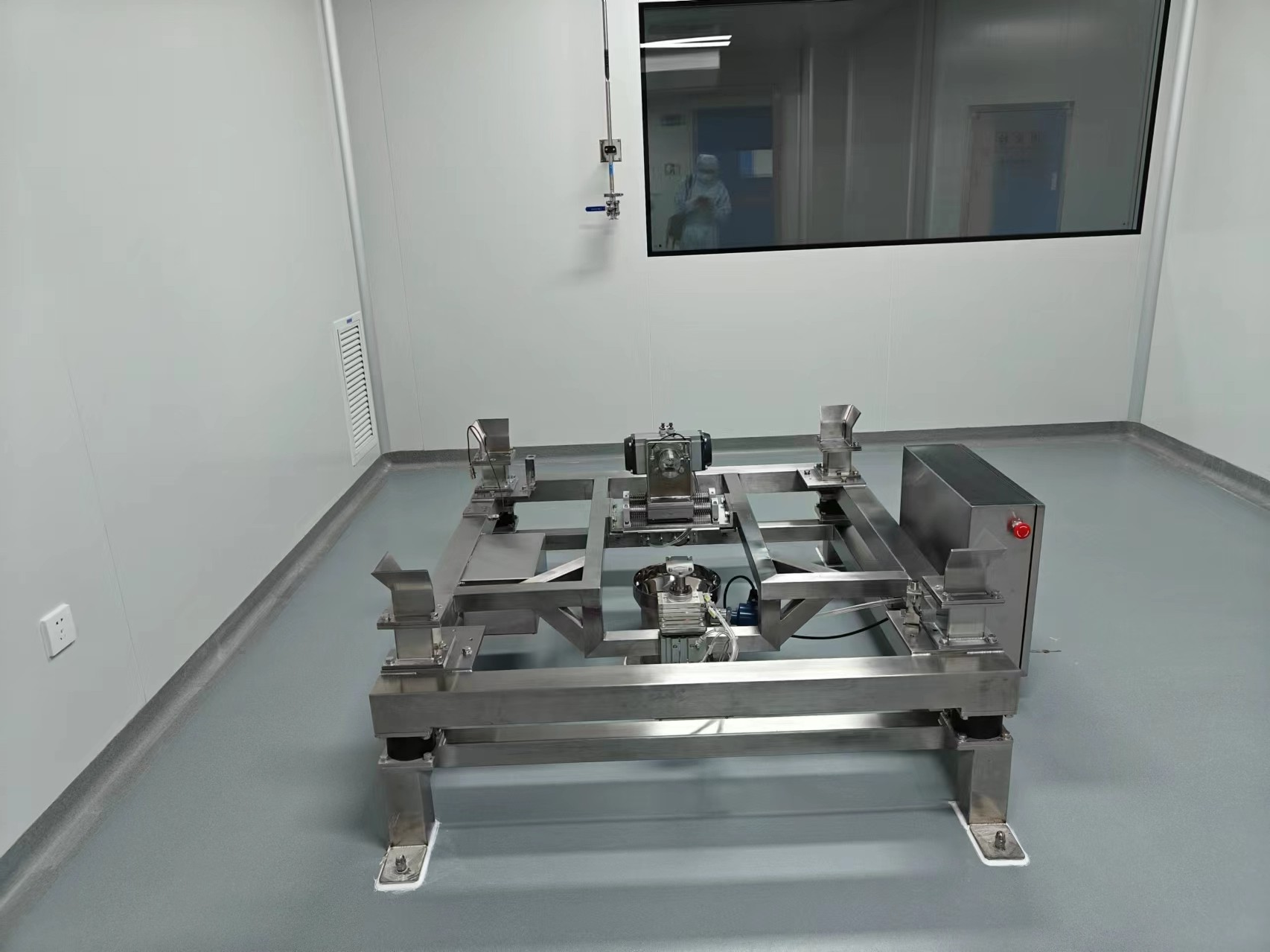
Weighing function
By adding a weighing module, the weight discharged from the IBC bin can be accurately measured.
Automatic lid opening and closing
When the no-IBC bin is connected, the feeding port of the discharge station will be automatically covered by the lid.
Valve plate dust cleaning function
By means of pulse blowing, the discharge valve of the IBC bin is blown to reduce the material residue on the surface of the valve plate. The material residue on the surface of the valve plate can pollute the working environment during the turnover of the IBC bin and may also cause the trolley to slip and bring certain dangers.
IBC bin vibrating device
It is divided into two structural forms, automatic and manual. It directly acts on the IBC bin to prevent material residue inside the bin.
The in-place inner wall cleaning and wetting function of the IBC bin
Non-standard customization and matching with a cleaning machine are required. After the material transportation is completed, the IBC bins do not need to be removed. The inner walls of the IBC bins and the discharge station can be directly cleaned and moistened.